Functions
Functions are dynamic {{ }} tokens that compute a value at send time instead
of looking one up from a variable. Use them to
stamp a request with a fresh UUID, the current timestamp, a Base64-encoded
credential, an HMAC signature, or a value pulled from another request's response.
Where a {{variable}} resolves to a stored value, a function like {{uuid()}}
runs every time the request is sent — so each send gets a new result.
Inserting a function
Type {{ in any field to open the typeahead. Below your variables it lists
the available functions, grouped into sections:
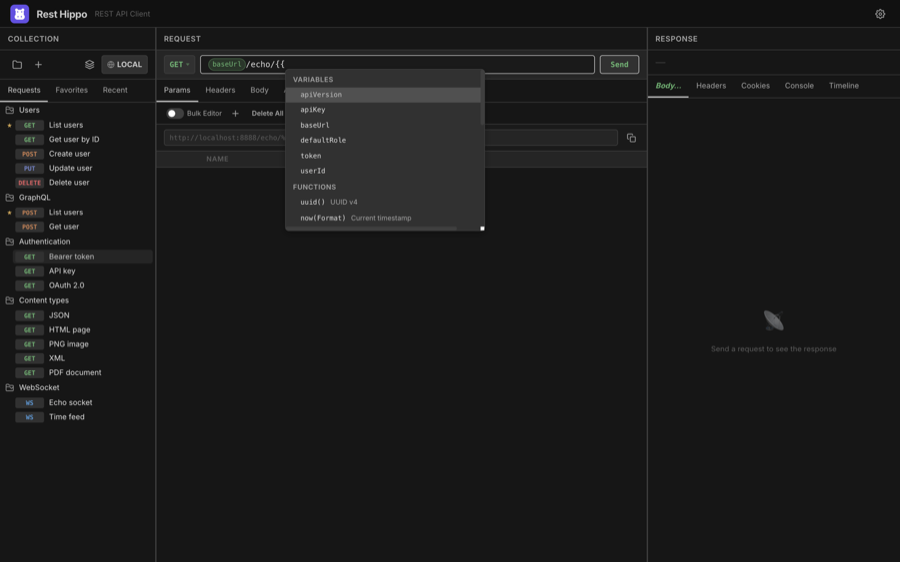
Pick a function and Rest Hippo inserts it as a highlighted pill. If the function takes arguments, the pill editor opens so you can fill them in; click an existing function pill any time to edit its arguments again.
The pill editor (for both variables and functions) shows a Live Preview of
the resolved value. To copy it, double-click the preview value to select it
and press Cmd/Ctrl+C, or right-click it for a Copy / Select All menu.
Secret values copy as *** until you reveal them with the eye toggle.
Under the hood a function pill is just text in the form
{{name("arg1", "arg2")}} — arguments are positional and double-quoted — so you
can also type one by hand. {{uuid()}} takes no arguments; {{now("Unix")}}
takes one.
Built-in functions
General-purpose helpers that resolve instantly, with no network or context needed.
| Function | Result |
|---|---|
uuid() |
A random UUID v4, e.g. 9f1c…-…. A fresh one on every send. |
now("ISO") |
The current timestamp. Format: ISO (default), Unix (seconds), UnixMs (milliseconds), or RFC2822. |
base64encode("value") |
Base64-encode the value (UTF-8 safe). |
base64decode("value") |
Base64-decode the value. |
urlEncode("value") |
Percent-encode the value for use in a URL. |
urlDecode("value") |
Percent-decode the value. |
randomInt("0", "100") |
A random integer between min and max, inclusive (defaults 0–100). |
Arguments can themselves contain variables — e.g. {{base64encode("{{user}}:{{pass}}")}}
builds a Basic-auth credential from two variables.
Context functions
These read from where the request lives and the active environment. They take no network round-trip.
| Function | Result |
|---|---|
collectionName() |
The name of the active collection. |
requestName() |
The name of the current request. |
environmentName() |
The name of the active environment. |
folderName("0") |
An ancestor folder's name. 0 is the immediate parent, 1 its parent, and so on. |
Request Outputs
Chain requests together: pull a value out of another request's response and feed it into this one. Reference the source request by name.
| Function | Result |
|---|---|
response("Login", ".data.token") |
A value from the named request's response body. The second argument is a dot-path (.data.token, .items.[0].id); . returns the whole body. |
responseHeader("Login", "Location") |
A single response header from the named request. |
responseStatus("Login") |
The HTTP status code of the named request's last response. |
run("Seed data") |
Runs the named request before this one. It produces no text of its own (it resolves to an empty string) — use it purely to trigger a prerequisite. |
The dot-path is the same syntax as response captures and works over JSON, YAML, or XML bodies.
Refresh mode
response, responseHeader, and responseStatus each have a Refresh mode:
- Use last result (default) — read the value from the source request's most recent response, without re-sending it. Fast, but the source must have been run at least once.
- Run immediately before — send the source request first, every time, then read from its fresh response. Use this when the value is short-lived (e.g. a one-time token) and must be current on every send.
Backend functions
These run in Rest Hippo's main process (where the crypto and OS APIs live) and resolve asynchronously.
| Function | Result |
|---|---|
hmac("SHA256", "key", "message") |
An HMAC signature. Algorithm: SHA256 (default) or SHA512. |
hash("SHA256", "value") |
A hash of the value. Algorithm: SHA256 (default) or SHA512. |
environmentVariable("RESTHIPPO_API_KEY") |
An OS environment variable. For safety, only names beginning with RESTHIPPO_ are readable — any other name returns empty, and the prefix is not stripped. |
environmentVariable lets you keep a secret out of your stored collection
entirely: export RESTHIPPO_API_KEY=… in your shell before launching Rest Hippo,
then reference it with {{environmentVariable("RESTHIPPO_API_KEY")}}.
Next: GraphQL →